Area Real Estate News & Market Trends

You’ll find our blog to be a wealth of information, covering everything from local market statistics and home values to community happenings. That’s because we care about the community and want to help you find your place in it. Please reach out if you have any questions at all. We’d love to talk with you!

May 29, 2026

An Expert Makes All the Difference When You Sell Your House

An Expert Makes All the Difference When You Sell Your House | MyKCM


If you’re thinking of selling your house, it’s important to work with someone who understands how the market is changing and what it means for you. Here are five reasons working with a professional can ensure you’ll get the most out of your sale.

1. They’re Experts on Market Trends

With today’s housing market defined by change, it’s critical to work with someone who knows the latest information and how it impacts your goals. An expert real estate advisor knows about national trends and your local area too. More importantly, they’ll give insight to what all of this means for you, so they’ll be able to help you make a decision based on trustworthy, data-bound information.

2. A Local Professional Knows How To Set the Right Price for Your Home

Home price appreciation has moderated this year. If you sell your house on your own, you may be more likely to overshoot your asking price because you’re not as aware of where prices are today. Pricing your house too high can deter buyers or cause your house to sit on the market for longer.

Real estate professionals look at a variety of factors, like the condition of your home and any upgrades you’ve made, with an unbiased eye. They compare your house to recently sold homes in your area to find the best price for today’s market so your house sells quickly.

3. A Real Estate Advisor Helps Maximize Your Pool of Buyers

Since buyer demand has cooled this year, you’ll want to do what you can to help bring in more buyers. Real estate professionals have a wide range of tools at their disposal, such as social media followers, agency resources, and the Multiple Listing Service (MLS), to ensure your house gets in front of people looking to make a purchase. Investopedia explains why it’s risky to sell on your own without the network an agent provides:

“You don’t have relationships with clients, other agents, or a real estate agency to bring the largest pool of potential buyers to your home.”

Without access to your agent’s tools and marketing expertise, your buyer pool – and your home’s selling potential – is limited.

4. A Real Estate Expert Will Read – and Understand – the Fine Print

Today, more disclosures and regulations are mandatory when selling a house. That means the number of legal documents you’ll need to juggle is growing. The National Association of Realtors (NAR) puts it like this:

“There’s a lot of jargon involved in a real estate transaction; you want to work with a professional who can speak the language.”

5. A Local Professional Is a Skilled Negotiator

In today’s market, buyers are regaining some negotiation power. If you sell without an expert, you’ll be responsible for any back-and-forth. That means you’ll have to coordinate with:

  • The buyer, who wants the best deal possible
  • The buyer’s agent, who will use their expertise to advocate for the buyer
  • The inspection company, which works for the buyer and will almost always find concerns with the house
  • The appraiser, who assesses the property’s value to protect the lender

Instead of going toe-to-toe with these parties alone, lean on an expert. They’ll know what levers to pull, how to address everyone’s concerns, and when you may want to get a second opinion.

Bottom Line

Don’t go at it alone. If you’re planning to sell your house this spring, let’s connect so you have an expert by your side to guide you in today’s market.


Posted in Sellers
May 29, 2026

The Role of Access in Selling Your House

Once you’ve made the decision to sell your house and have hired a real estate agent to help, they’ll ask how much access to your home you want to give potential buyers. Your answer matters more now than it did in recent years. Here’s why.

At the height of the buying frenzy seen during the pandemic, there was a rise in the number of homebuyers who put offers on houses sight unseen. That happened for three reasons:

  • Extremely low housing inventory
  • A lot of competition from other buyers wanting to take advantage of historically low mortgage rates
  • And general wariness of in-person home tours during a pandemic

Today, the market’s changing, and buyers can usually be more selective and take more time to explore their options.

So, in order to show your house and sell it efficiently, you’ll want to provide buyers with as much access as you can. Before letting your agent know what works for you, consider these five levels of access you can provide. They’re ordered from most convenient for a buyer to least convenient. Remember, your agent will be better able to sell your house if you provide as much access to buyers as possible.

  1. Lockbox on the Door – This allows buyers the ability to see the home as soon as they are aware of the listing or at their convenience.
  2. Providing a Key to the Home – This would require an agent to stop by an office to pick up the key, which is still pretty convenient for a buyer.
  3. Open Access with a Phone Call – This means you allow a showing with just a phone call’s notice.
  4. By Appointment Only – For example, you might want your agent to set up a showing at a particular time and give you advance notice. That way you can prepare the house and be sure you have somewhere else you can go in the meantime.
  5. Limited Access – This might mean you’re only willing to have your house available on certain days or at certain times of day. In general, this is the most difficult and least flexible way to show your house to potential buyers.

As today’s housing market changes, be sure to work with your local agent to give buyers as much access as you can to your house when you sell.

Posted in Sellers
May 29, 2026

Why Homeownership Wins in the Long Run

Today’s higher mortgage rates, inflationary pressures, and concerns about a potential recession have some people questioning: should I still buy a home this year? While it’s true this year has unique challenges for homebuyers, it’s important to think about the long-term benefits of homeownership when making your decision.

Consider this: if you know people who bought a home 5, 10, or even 30 years ago, you’re probably going to have a hard time finding someone who regrets their decision. Why is that? The reason is tied to how home values grow with time and how, by extension, that grows your own wealth. That may be why, in a recent Fannie Mae survey, 70% of respondents say they believe buying a home is a safe investment.

Here’s a look at how just the home price appreciation piece can really add up over the years.

Home Price Growth over Time

The map below uses data from the Federal Housing Finance Agency (FHFA) to show just how noteworthy price gains have been over the last five years. And, since home prices vary by area, the map is broken out regionally to help convey larger market trends.

If you look at the percent change in home prices, you can see home prices grew on average by just over 56% nationwide over a five-year period.

Some regions are slightly above or below that average, but overall, home prices gained solid ground in a short time. And if you expand that time frame even more, the benefit of homeownership and the drastic gains homeowners made over the years become even clearer (see map below):

The second map shows, nationwide, home prices appreciated by an average of over 290% over a roughly 30-year span.

 This nationwide average tells you the typical homeowner who bought a house 30 years ago saw their home almost triple in value over that time. That’s a key factor in why so many homeowners who bought their homes years ago are still happy with their decision.

And while you may have heard talk in late 2022 that home prices would crash, it didn’t happen. Even though home prices have moderated from the record peak we saw during the ‘unicorn’ years, prices are already rebounding in many areas today. That means, in most markets, your home should grow in value over the next year.

The alternative to buying a home is renting, and rental prices have been climbing for decades. So why rent and deal with annual lease hikes for no long-term financial benefit? Instead, consider buying a home.

Bottom Line

If you’re questioning if it still makes sense to buy a home today, remember the incredible long-term benefits of homeownership. If you’re ready to start the conversation, let’s connect today.

Posted in Buyers, Investing
May 29, 2026

Real Estate Is Still Considered the Best Long-Term Investment

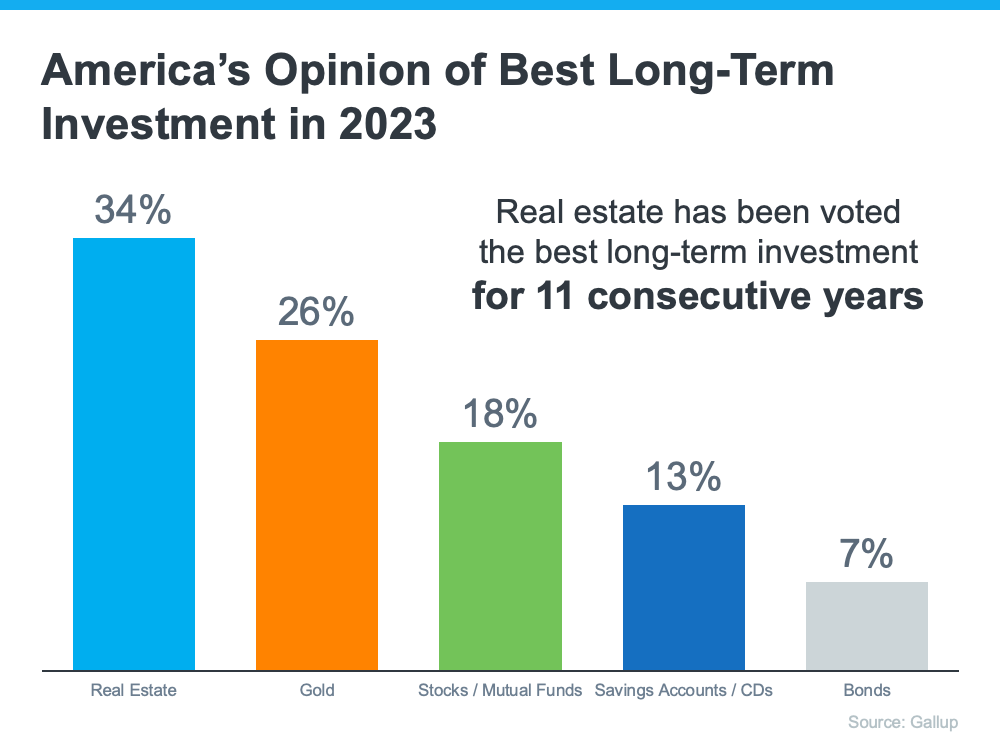
With all the headlines circulating about home prices and rising mortgage rates, you may wonder if it still makes sense to invest in homeownership right now. A recent poll from Gallup shows the answer is yes. In fact, real estate was voted the best long-term investment for the 11th consecutive year, consistently beating other investment types like gold, stocks, and bonds (see graph below):

If you’re thinking about purchasing a home, let this poll reassure you. Even with everything happening today, Americans recognize owning a home is a powerful financial decision.

Why Do Americans Still Feel So Positive About the Value of Investing in a Home?

Purchasing real estate has typically been a solid long-term strategy for building wealth in America. As Lawrence Yun, Chief Economist at the National Association of Realtors (NAR), notes:

“. . . homeownership is a catalyst for building wealth for people from all walks of life. A monthly mortgage payment is often considered a forced savings account that helps homeowners build a net worth about 40 times higher than that of a renter.”

That’s because owning a home grows your net worth over time as your home appreciates in value and as you pay down your mortgage. And, since building that wealth takes time, it may make sense to start as soon as you can. If you wait to buy and keep renting, you’ll miss out on those monthly housing payments going toward your home equity.

Bottom Line

Buying a home is a powerful decision. So, it’s no wonder so many people view real estate as the best long-term investment. If you’re ready to start on your own journey toward homeownership, let’s connect today.

Posted in Buyers, Investing, Sellers
May 29, 2026

Owning Your Home Helps You Build Wealth


You may have heard some people say it’s better to rent than buy a home right now. But, even today, there are lots of good reasons to become a homeowner. One of them is that owning a home is typically viewed as a good long-term investment that helps your net worth grow over time.

Homeownership Builds Wealth Regardless of Income Level

You may be surprised to learn homeowners across various income levels have a much higher net worth than renters who make the same amount. Data from First American helps illustrate this point (see graph below):

What makes wealth so much higher for homeowners? A recent article from Realtor.com says:

“Homeownership has long been tied to building wealth—and for good reason. Instead of throwing rent money out the window each month, owning a home allows you to build home equity. And over time, equity can turn your mortgage debt into a sizeable asset.”

Basically, the wealth you accumulate when you own a home has a lot to do with equity. As a homeowner, equity is built up as you pay down your loan and as home prices appreciate over time. Mark Fleming, Chief Economist at First American, explains how this same benefit isn’t true for renters in a recent podcast:

“Renters as non-homeowners gain no wealth benefit as home prices rise. That wealth actually accrues to the landlord.”

Before you decide to sign another rental agreement, now is a good time to think about whether it would be better for you to buy a home instead. The best way to figure out what makes sense for you is to have a conversation with a real estate expert you trust. That professional can talk you through the benefits that come with owning to determine if that’s the right next step for you. 

Bottom Line

If you're not sure whether to keep renting or to buy a home, know that owning a home, no matter how much money you make, can help build your wealth. Let's connect now to get started on the path to homeownership.

Posted in Buyers, Investing, Sellers
May 29, 2026

How To Know If You’re Ready to Buy a Home


If you’re trying to decide if you’re ready to buy a home, there’s probably a lot on your mind. You’re thinking about your finances, today’s mortgage rates and home prices, the limited supply of homes for sale, and more. And, you’re juggling how all of those things will impact the choice you’ll make.

While housing market conditions are definitely a factor in your decision, your own life and your finances may be even more important. As an article from NerdWallet says:

“Housing market trends give important context. But whether this is a good time to buy a house also depends on your financial situation, life goals and readiness to become a homeowner.”

Instead of trying to time the market, it may help to focus on what you can control. Here are a few questions that can give you clarity on whether you’re ready to make your move.

1. Do You Have a Stable Job?

One thing to consider is how stable you feel your employment is. Buying a home is a big purchase, and you’re going to sign a home loan stating you’re going to pay that loan back. That can feel like a big obligation. Knowing you have a reliable job and income coming in can help put your mind at ease. As NerdWallet explains:

“A mortgage is a big commitment . . . Wait until your employment is stable before thinking about buying a house.”

2. Have You Figured Out What You Can Afford?

To make sure you have a good idea of what you’ll need to save and what you can expect to spend on your monthly payment, talk to a trusted lender. They’ll be able to tell you about the pre-approval process and what you can borrow, current mortgage rates and approximate monthly payments, closing costs to anticipate, what percent of the purchase price of the home you’ll need for a down payment, and more.

The best part is you may find out you’re closer to your goals than you realized. You don’t necessarily need to put 20% down, unless it’s specified by your lender or loan type. As Down Payment Resource says:

“A 20% down payment on a home is great, but . . . Many mortgages require no more than 3% to 5% of the purchase price as a down payment. Plus, there are loans and grants that may help cover these costs. Search for down payment assistance in your area, and discuss your results with your mortgage lender . . .”

3. How Long Do You Plan to Live There?

Another important thing to think about is how long you plan to stay put. It takes time to build equity in your home through paying down your loan and home price appreciation. If you plan to move too soon, you may not recoup your investment. For example, if you’re looking to sell and move again in a year, it might not make sense to buy right now. As a recent article from CNET says:

Buying a home is a good idea if you’re planning to stay put for at least three years. Home values typically increase between 2% and 5% annually, so you could end up paying more in closing costs than you’d earn in proceeds if you sell after only a year or two.”

So, think about your future. If you plan to transfer to a new city with the upcoming promotion you’re working toward or you anticipate your loved ones will need you to move closer to take care of them, that’s something to factor in.

Above all else, the most important question to answer is: do you have a team of real estate professionals in place? If not, finding a trusted local agent and a lender is a good first step.

Bottom Line

If you’re trying to decide if you’re ready to buy a home, these questions can help. But ultimately, your best and more reliable resource is the help of trusted real estate professionals.

Posted in Buyers
May 29, 2026

Writing a Strong Offer

Home Purchase Offer

As a homebuyer, you’ll face one of three types of real estate markets as you embark on home ownership: buyers’, sellers’ and balanced. The type of offer you’ll want to submit is highly dependent on the current market.

In a market where there are lots of homes for sale and few buyers competing for them, a buyer has a different set of objectives than when the market is searing, with few homes for sale and lots of buyer competition.

Let’s break these markets down and figure out what type of offer is appropriate to each.

Buyer’s Market

A buyer’s market is high in housing inventory and low in other buyers. This is the ideal time to shop for a home because homeowners are actually competing for your interest. With the buyer in the driver’s seat, sellers are willing to make concessions that they wouldn’t otherwise consider, just to get the home sold.

A strong offer in this market -- as long as the house is priced appropriately -- meets the seller’s asking price but loads up on concessions. Hate the carpet? Ask for a carpet allowance. If you’re low on cash, ask the seller to assist with closing costs.

The seller considers it a strong offer because you’ve met the price. It is strong for you, the buyer, because you are receiving credit for items you want repaired or replaced or a financial concession. In this situation, it’s a win-win for both parties.

Be aware that some government-backed loan programs specify which items the seller must pay at closing.

Seller’s Market

“Highest and best” is a term you’ll often hear during an overheated seller’s market, when there are few homes available to lots of buyers. It s the strongest offer one can submit on a home for sale.

In this market, prices typically tend to escalate quickly (the old supply-and-demand economic model at work) and bidding on homes sometimes becomes frenzied.

Before a seller’s market becomes overheated you’ll typically be faced with competition from investors – those guys and gals that come in waving lots of cash and proffering enticing promises to close quickly. Because prices are still low, this stage of the market is also generally full of first-time homebuyers who get locked out of the process by the cash-laden investors.

Although it’s not impossible to win against these buyers, it is challenging. The most important thing to remember is that the seller is in charge. Because of this, don’t plan on receiving any concessions from the seller. In fact, don’t ask for them. If you do, and there is a clean cash offer, you will lose.

To beef up your offer, consider doing the following:

  • Go through the offer with your agent and look for ways to shorten time limits – offer to have the home inspection complete within one week, for instance.
  • Skip asking for seller concessions.
  • If you have the money, offer to pay your real estate agent’s commission. This gives the seller an extra three percent of the sales price at the closing table.
  • Consider shopping for homes priced under your maximum loan limit to give yourself more money to use as seller incentives – such as the aforementioned credit for your agent’s commission.

The Balanced Market

Any time a local real estate market has five to six month inventory of available homes, it is considered balanced. In a balanced market, buyers and sellers have equal control and leisurely negotiations are common.

Your number one tool in any market will be your real estate agent, so choose wisely.

Posted in Buyers
May 29, 2026

Why You Should Not Sell or Buy For Sale By Owner

In today’s market, as home prices rise and a lack of inventory continues, some homeowners may consider trying to sell their homes on their own, known in the industry as a For Sale by Owner (FSBO). There are several reasons why this might not be a good idea for most sellers.

Here are the top five reasons:

1. Exposure to Prospective Buyers

According to NAR’s 2018 Profile of Home Buyers and Sellers, 95% of buyers searched online for a home last year. That is in comparison to only 13% of buyers looking at print newspaper ads. Most real estate agents have an Internet strategy to promote the sale of your home, do you?

2. Results Come from the Internet

Where did buyers find the homes they actually purchased?

  • 50% on the Internet
  • 28% from a real estate agent
  • 7% from a yard sign
  • 1% from newspapers

The days of selling your house by putting out a lawn sign or putting an ad in the paper are long gone. Having a strong Internet strategy is crucial.

3. There Are Too Many People to Negotiate With

Here is a list of some of the people with whom you must be prepared to negotiate if you decide to For Sale by Owner:

  • The buyer who wants the best deal possible
  • The buyer’s agent who solely represents the best interests of the buyer
  • The buyer’s attorney (in some parts of the country)
  • The home inspection companies, which work for the buyer and will almost always find some problems with the house
  • The appraiser if there is a question of value

4. FSBOing Has Become More And More Difficult

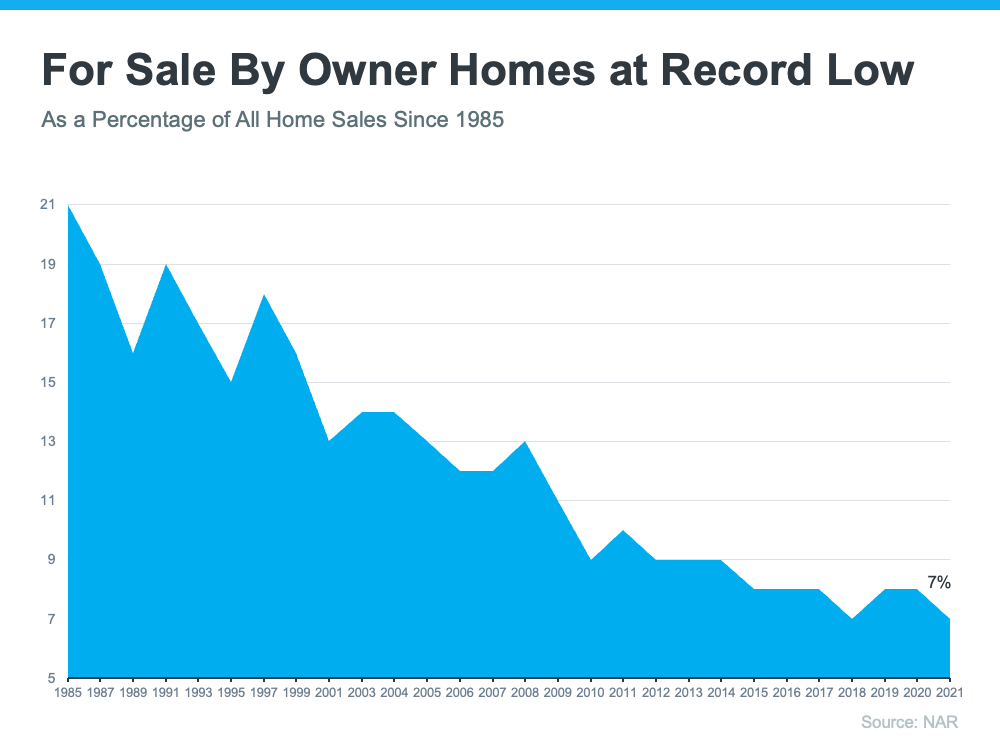
The paperwork involved in selling and buying a home has increased dramatically as industry disclosures and regulations have become mandatory. This is one of the reasons that the percentage of people FSBOing has ped from 19% to 7% over the last 20+ years.

5. You Net More Money When Using an Agent

Many homeowners believe that they can save on the real estate commission by selling on their own, but they don’t realize that the main reason buyers look at FSBOs is because they also believe that they can save on the real estate agent’s commission. The seller and buyer can’t both save the commission.

A study by Collateral Analytics revealed that FSBOs don’t actually save anything, and in some cases may be costing themselves more, by not listing with an agent. One of the main reasons for the price difference at the time of sale is that,

“Properties listed with a broker that is a member of the local MLS will be listed online with all other participating broker websites, marketing the home to a much larger buyer population. And those MLS properties generally offer compensation to agents who represent buyers, incentivizing them to show and sell the property and again potentially enlarging the buyer pool.”

If more buyers see a home, the greater the chances are that there could be a bidding war for the property. The study showed that the difference in price between comparable homes of size and location is currently at an average of 6% this year.

Why would you choose to list on your own and manage the entire transaction when you can hire an agent and not have to pay anything more?

Bottom Line

Before you decide to take on the challenges of selling your house on your own, sit with a real estate professional in your marketplace and see what they have to offer. Call us for more information 602-348-8773


Posted in Buyers, Sellers
May 29, 2026

Why a Real Estate Professional Is Key When Selling Your House

Why a Real Estate Professional Is Key When Selling Your House | MyKCM


With today’s real estate market moving as fast as it is, working with a real estate professional is more essential than ever. They have the skills, experience, and expertise it takes to navigate the highly detailed and involved process of selling a home. That may be why the percentage of people who list their houses on their own, known as a FSBO or For Sale By Owner, has reached its lowest point since 1985 (see graph below):

Why a Real Estate Professional Is Key When Selling Your House | MyKCM

Here are five reasons why selling with a real estate professional makes more sense, even in today’s hot market:

1. They Know What Buyers Want To See

Before you decide which projects and repairs to take on, connect with a real estate professional. They have first-hand experience with today’s buyers, what they expect, and what you need to do to make sure your house shows well.

If you don’t lean on their expertise, you may spend your time and money on something that isn’t essential. That’s because, in today’s low-inventory market, buyers are willing to take on more of the renovation work themselves. A survey from Freddie Mac finds that:

“. . . nearly two-in-five potential homebuyers would consider purchasing a home requiring renovations.” 

A professional can help you decide what you need to tackle. It’s not canned advice you could find online – it’s recommendations specific to your house and your area.

2. They Help Maximize Your Buyer Pool

Today, the average home is getting 4.8 offers per sale according to recent data from the National Association of Realtors (NAR), and that competition is pushing prices up. While that’s promising for you as a seller, it’s important to understand your agent’s role in bringing buyers in.

Real estate professionals have an assortment of tools at their disposal, such as social media followers, agency resources, and the MLS to ensure your house is viewed by the most buyers. According to realtor.com:

Only licensed real estate agents can list homes on the MLS, which is a one-stop online shop of sorts for getting a house seen by thousands of agents and home buyers. . . . This is certainly one of many good reasons why the majority of home sellers decide to employ the services of a listing agent rather than going it alone.”

Without access to these tools, your buyer pool is limited. And you want more buyers to view your house since buyer competition can drive your final sales price higher.

3. They Understand the Fine Print

Today, more disclosures and regulations are mandatory when selling a house. That means the number of legal documents you’ll need to juggle is growing. That’s why Investopedia says:

One of the biggest risks of FSBO is not having the experience or expertise to navigate all of the legal and regulatory requirements that come with selling a home.”

A real estate professional knows exactly what needs to happen, what all the paperwork means, and how to work through it efficiently. They’ll help you review the documents and avoid any costly missteps that could occur if you try to handle them on your own.

4. They’re Trained Negotiators

If you sell without a professional, you’ll also be solely responsible for all the negotiations. That means you’ll have to coordinate with:

  • The buyer, who wants the best deal possible
  • The buyer’s agent, who will use their expertise to advocate for the buyer
  • The inspection company, which works for the buyer and will almost always find concerns with the house
  • The appraiser, who assesses the property’s value to protect the lender

Instead of going toe-to-toe with all these parties alone, lean on an expert. They’ll know what levers to pull, how to address everyone’s concerns, and when you may want to get a second opinion.

5. They Know How To Set the Right Price for Your House

If you sell your house on your own, you may over or undershoot your asking price. That could mean you’ll leave money on the table because you priced it too low or your house will sit on the market because you priced it too high. Pricing a house requires expertise. Investopedia explains it like this:

. . . There is no easy or universal way to determine market value for real estate.

Real estate professionals know the ins and outs of how to price your house accurately and competitively. To do so, they compare your house to recently sold homes in your area and factor in the current condition of your house. These factors are key to making sure it’s priced to move quickly while still getting you the highest possible final sale price.

Bottom Line

There's a lot that goes into selling your house. Instead of tackling it alone, let’s connect so you have an expert on your side throughout the entire process.

Posted in Sellers
May 29, 2026

What to Look for in the HOA Documents

Home Owners Association

If you purchase a home in a managed community, congratulations, you’re about to become a member of, and be governed by, a homeowner’s association, also known as a HOA. You’ll be given a mountain of paperwork by this association and, believe me, these are some of the most important documents you’ll read in your lifetime.

This paperwork package is known as the Resale Disclosure Package in some areas, or merely “HOA Docs” in others. Now, I didn’t say these documents would be interesting; unless you are an accountant or a lawyer, you’ll be bored silly. They do contain, however, information that is vital to your decision as to whether or not to purchase the home. Let’s take a look at some of these documents and how they might affect your that decision.

CC&Rs

This acronym stands for covenants, conditions and restrictions. These are the governing documents for the HOA and the rules that you, your guests and your tenants must abide by. From the number and size of pets you can keep in the community to where you are legally able to park, the CC&Rs will dictate how you live.

Failure to abide by the rules means a hefty fine. If the fine goes unpaid, the HOA can pursue foreclosure proceedings on your property. Here are just a few of the items that may be regulated by the CC&Rs:

  • Landscaping
  • Exterior paint color
  • Noise
  • Outdoor play equipment such as swing sets and basketball hoops
  • Window coverings
  • Garages and outbuildings
  • Mailboxes
  • Holiday decorations
  • Parking
  • Garbage and recycling containers
  • Home businesses

What to Look for in HOA Documents

Several documents in the HOA package require close scrutiny. Look for the following:

Litigation

The HOA may have a lawsuit underway or pending for any number of reasons. The most typical litigation is against the builder for construction or structural defects but the litigation may also be against the HOA, such as in a slip-and-fall situation. Most lenders won’t approve a loan until the litigation is settled.

Special Assessments

Special assessments are levied against HOA members to remedy a shortfall in the reserves fund. Determining how much to set aside in the reserve fund every year isn’t an exact science. Then, events such as homeowners not paying their dues and underestimating the cost of expensive repairs can deplete the reserves. HOAs then either raise the monthly HOA fee or levy a special assessment. Consider it a red flag if the latter has happened frequently over the life of the HOA.

While you look through this part of the HOA documents, look for mention of any major projects planned and whether the HOA reserve fund can cover their costs.

Meeting Minutes

HOA meeting minutes hold some interesting tidbits of information. One of the first things to look at is the complaints from homeowners – look even more carefully to see if these complaints are voiced repeatedly, over the course of several meetings. If they are, the HOA may be unresponsive to homeowner complaints, another potential red flag.

No matter how attractive that condo is, or how appealing the common areas and amenities are, it’s not worth buying if the CC&Rs impact your lifestyle and restrict your freedom. If you have any questions about what you find in the documents, have your attorney review them.

Posted in Buyers, Sellers