Area Real Estate News & Market Trends

You’ll find our blog to be a wealth of information, covering everything from local market statistics and home values to community happenings. That’s because we care about the community and want to help you find your place in it. Please reach out if you have any questions at all. We’d love to talk with you!

May 29, 2026

Think You Have To Put 20% Down? Most First-Time Homebuyers Don’t.

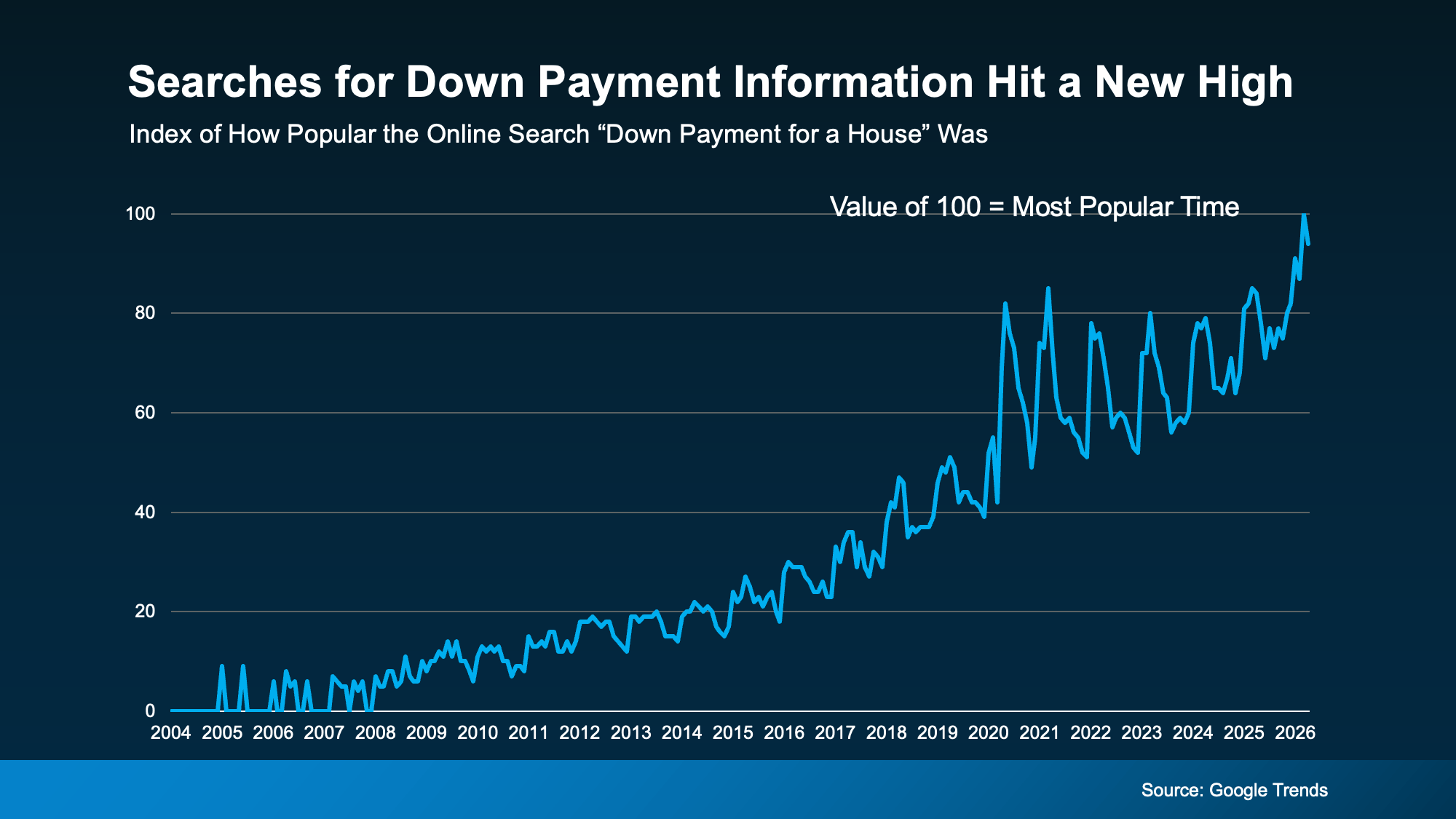
According to Google Trends, online searches for down payment information recently hit an all-time high. And that’s a clear sign more buyers are trying to figure out what they really need to save before making a move (see graph below):
a graph of a line graphIf you’re wondering the same thing, you can always turn to the internet for answers. But a lot of the time, it’s better to ask a local expert. Because here’s what a pro would tell you.

The 20% Down Payment Myth

The idea that you need 20% down to buy a home is one of the biggest misconceptions around the homebuying process. And the data debunks the myth.

While there are benefits to putting that much money down, most first-time buyers put down far less.

Here’s why. Unless it’s stated by your lender, you typically don’t have to have a 20% down payment. There are even some loan options designed to help you get into a home with a much smaller upfront cost. As the Mortgage Reports explains:

“The amount you need to put down will depend on a variety of factors, including the loan type and your financial goals. If you don’t have a large down payment saved up, don’t worry—there are plenty of options available, and you don’t need to put down the traditional 20% . . . many homebuyers are able to secure a home with as little as 3% or even no down payment at all . . .

For example, FHA loans allow down payments as low as 3.5%, while VA and USDA loans offer zero down payment options for qualified applicants, like Veterans.

And those options are just one reason so many first-time buyers are able to buy without a 20% down payment.

What Buyers Are Actually Putting Down

So, if buyers aren’t doing 20%, how much do they actually put down?

According to the National Association of Realtors (NAR), the median down payment for first-time homebuyers is only 10%. That’s half of what you probably expected.
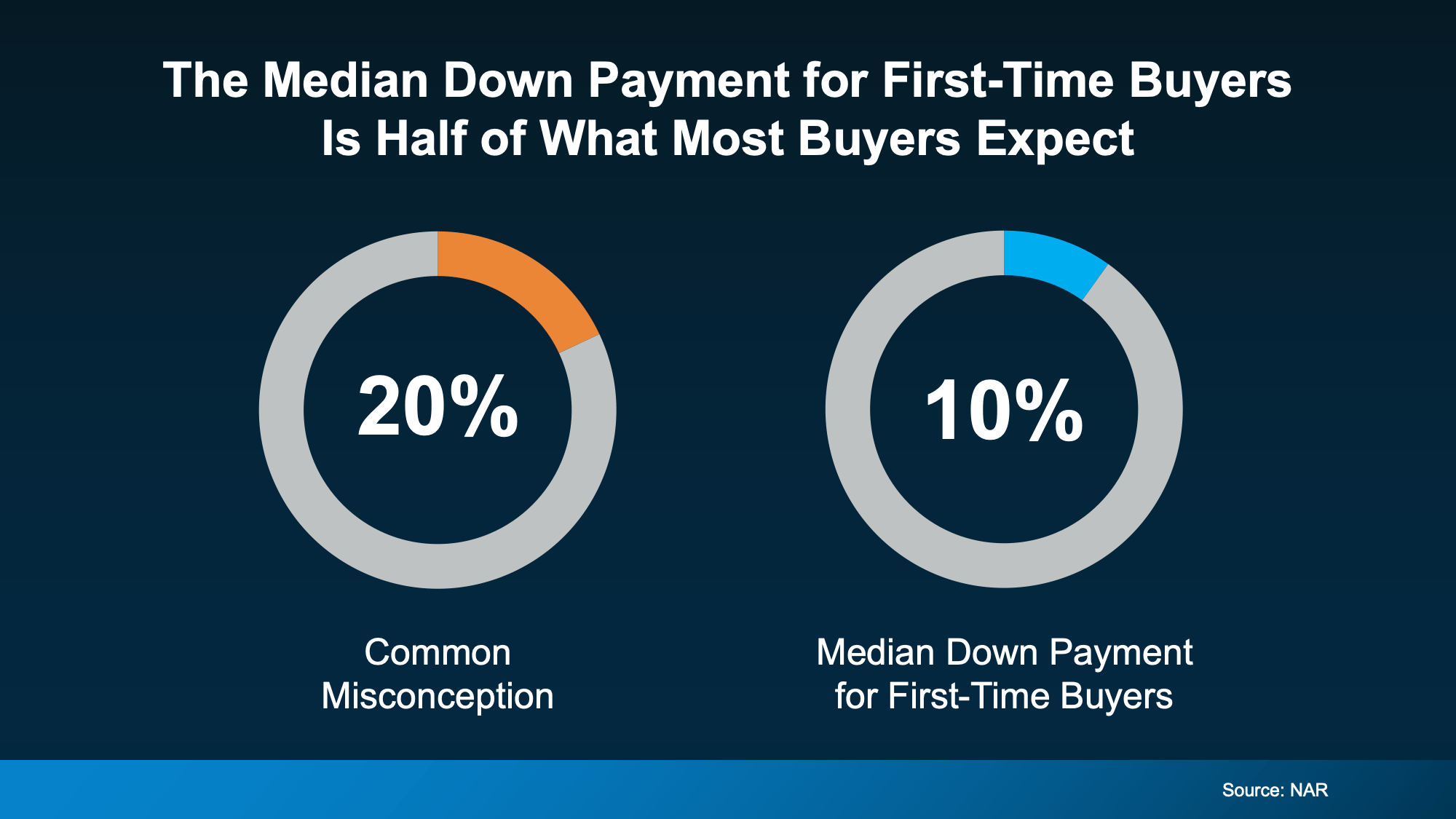
a diagram of a pie chartThat means if you’re aiming to save 20% because you think you have to, you may be setting a timeline that’s longer than necessary.  

And here’s some more good news. It’s not only that you may be able to buy with less money down than you thought, but there are also options to help you get to your down payment goal even faster.

Why You Should Look into Down Payment Assistance Programs

There are a lot of programs designed to help you save for a down payment – and they can make a big difference in how fast you hit your savings target. Unfortunately, buyers don’t realize how many there are, or that they may qualify for help.

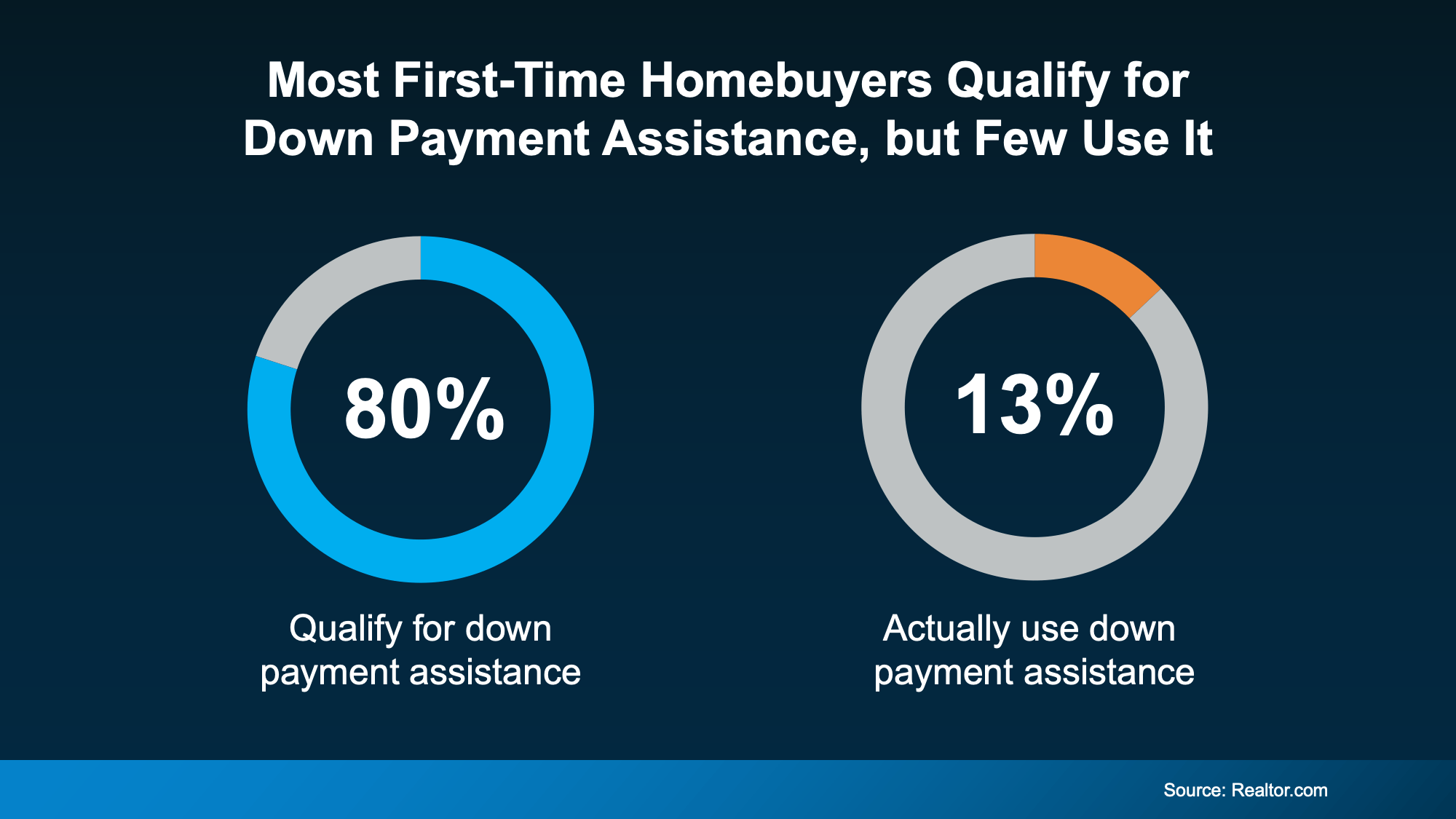
Research from Realtor.com shows almost 80% of first-time homebuyers qualify for down payment assistance (DPA), but only 13% actually use it (see chart below)

a blue and orange pie chartAnd that’s another big miss holding would-be buyers like you back.

In the U.S., there are over 2,600 homeownership programs available, many offering significant financial support. As Down Payment Resource shares:

With an average benefit of $18,000, down payment assistance (DPA) remains one of the most essential tools for addressing the nation’s affordability challenges. Programs continue to expand in scope, serving a broader range of incomes, property types and borrower needs, including first-generation, military and repeat buyers.

Imagine how much further your savings could go with an extra $18,000 you can use to buy. In some cases, you may even be able to stack multiple programs, giving what you’ve saved an even bigger boost.

Bottom Line

The simple truth is: most first-time buyers don’t put 20% down. And if you’ve been waiting to buy until you have that saved, you may be setting a timeline that’s longer than necessary.

To find out what you really need to save and if you qualify for any help, connect with a trusted lender who can walk you through your options. You may be able to buy sooner than you thought.

Posted in Buyers
May 29, 2026

How To Make Sure Your Sale Crosses the Finish Line

If there was one simple step that could help make your home sale a seamless process, wouldn't you want to know about it?

There’s a lot that happens from the time your house goes under contract to closing day. And a few things still have to go right for the deal to go through. But here’s what a lot of sellers may not know.

There's one part of the process where some homeowners are hitting a road bump that’s causing buyers to back out these days. But don’t worry. The majority of these snags are completely avoidable, especially when you understand what’s causing them and how to be proactive.

That’s where a great agent (and a little prep) can make all the difference.

What’s Causing Some Buyers To Back Out

The latest data from Redfin says 15% of pending home sales are falling through. And that’s not wildly higher than the 12% norm from 2017-2019. But it is an increase.

That means roughly 1 in 7 deals today don’t make it to the closing table. But, at the same time, 6 out of 7 do. So, the majority of sellers never face this problem – and odds are, you won’t either. But you can help make it even less likely if you know how to get ahead.

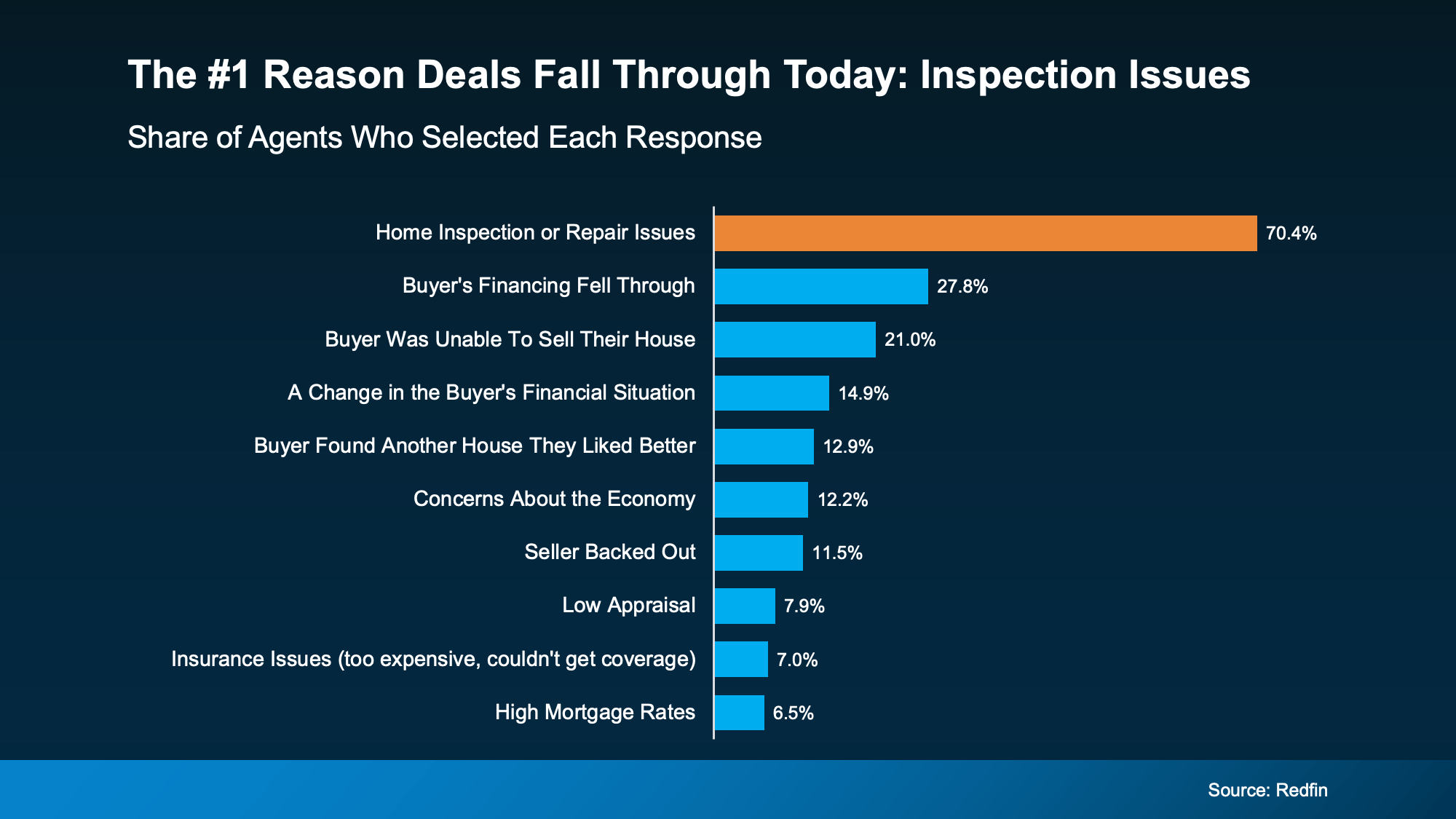
You might assume the main reason buyers are backing out today is financing. But that’s actually not the case. The most common deal breaker today, by far, is inspection and repair issues (see graph below):

a graph with text on itHere’s why that’s a sticking point for buyers right now:

  • Buyers are already stretched thin from high prices and challenging mortgage rates, so they don’t have the appetite (or budget) for unexpected repairs.
  • If they’re going to spend all that money, they want to get something that’s move-in ready. They don’t want to take on another high-cost project themselves.
  • They have more homes to choose from, so if yours seems like a hassle or if you’re not willing to fix something, they can just move on.

The sellers with the best agents have heard about this shift and they’re doing what they can to go in prepared. Enter the pre-listing inspection.

What’s a Pre-Listing Inspection?

It’s exactly what it sounds like. It’s a professional home inspection you schedule before your home hits the market. And while it’s not required, the National Association of Realtors (NAR) explains why it could be a valuable step for some sellers right now:

“To keep deals from unraveling . . . it allows a seller the opportunity to address any repairs before the For Sale sign even goes up. It also can help avoid surprises like a costly plumbing problem, a failing roof or an outdated electrical panel that could cause financially stretched buyers to bolt before closing.”

Think of it as a way to avoid future headaches. You’ll know what issues could pop up during the buyer’s inspection – and you’ll have time to fix them or decide what to disclose before you put your house on the market.

This way, when the buyer’s inspector walks in, you’re ready. No surprises. No last-minute panic. No deal on the line.

Is It Worth It?

Generally speaking, a pre-listing inspection costs just a few hundred dollars. So, it’s not a big expense. And the information it gives you is invaluable. But before you make that investment, talk to your local agent.

In some markets, it may not be worth it. And in others, it may be the best move you can make. It all depends on what’s happening where you are and what’s working for other local sellers. If your agent recommends getting one, they’ll also:

  • Help you decide which issues to fix
  • Prioritize repairs based on what buyers in your area are focusing on
  • Connect you with trusted professionals to get the work done
  • Ensure you understand local disclosure laws

That small step could save your deal (and your timeline).

Bottom Line

So, if there was one simple step that could help make your home sale go according to plan, would you do it?

If you’d rather deal with surprises on your terms (not with the clock ticking under contract), let’s talk about whether a pre-listing inspection makes sense for your house.

It may be worth it so you can hit the market confident, prepared, and in control.

Posted in Sellers
May 29, 2026

Home Appraisal Basics

Home Appraisal Basics

A big part of the home sale process is the appraisal. No matter how much a seller wants for his home, or how much a buyer is willing to pay for a home, in the end, it all comes down to the appraisal.

What is an Appraisal?

A real estate appraisal establishes the market value of a property: the amount of money a willing buyer will pay a willing seller. Since the home will be used as security for the buyer’s loan, the lender requires an appraisal to provide assurances that should the buyer default on the loan the lender can sell the home for the amount it is financing.

Once the home is under contract, the appraisal becomes what is known as a "contingency item." This means that the purchase of the home is contingent on the home appraising for the purchase price. If it doesn't, the buyer has the choice of walking out on the sale or renegotiating the price with the seller.

How Does the Process Work?

The appraisal is ordered by the buyer's lender, paid for by the buyer, and performed and compiled by a licensed appraiser who will, first of all, inspect the home. Then, he or she will look at the recent sales data for comparable houses in the neighborhood.

Ideally, the appraiser wants to find houses within a mile of yours that are of a similar type, age and size, that have sold within the past six months. In some real estate environments, this isn't an easy task. In sluggish markets, appraisers sometimes have to expand their geographical area or look at older sales.

Then, using his or her training, experience and judgment the appraiser will make adjustments to the sales prices of your home when comparing it to the others to arrive at a value for yours. This is the only value the bank will accept - not the CMA and not what the seller wants to get for the house - the appraisal is the final arbiter of what the home is worth.

If your purchase agreement has a sales price over that of the appraised value, the contract will need to be renegotiated to make sure the sale will go through. This is where your real estate agent earns his or her keep. Choose wisely.

Posted in Appraisal
May 27, 2026

Everything you need to Know about Relocating (Part 4)

Part 4

Once you’ve chosen a moving company it’s time to go over the contract. Read it thoroughly before signing it. Scrutinize it to ensure that it lists the correct price, that the pickup and delivery dates and times are as promised and that everything you asked to be put in writing is included.

Don’t sign any contract that has blank spaces or if it isn’t signed by the moving company.

Never pay an upfront deposit and never pay in full until you have thoroughly checked all of your belongings after delivery.

Watch out for things that Typically fall through the Cracks

Make a list of all the small tasks that need to get done before you move. These include:

  • Having your mail forwarded
  • Getting school, medical and veterinary records to take to your new city.
  • Notifying utilities, cable or satellite TV and Internet service for turn-off at the old house and turn-on at the new one.
  • Canceling newspaper subscriptions, cable service, Internet service, trash pickup and pool service.

Pack an essentials box. These are items you’ll need at the new house in the event that the moving van doesn’t arrive on time. Consider packing:

  • Bottled water
  • Snacks
  • Pet food
  • Toilet paper
  • The coffee maker, filters, coffee and cups
  • A shower curtain and hooks
  • Towels
  • Soap
  • Toiletries (shampoo, deodorant, etc)
  • A small safe or lockbox for your valuables
  • A copy of the mover’s contract and the written estimate.

Saying Goodbye

In the chaos of selling a home and tending to the details of the big move, don’t neglect your friendships. Especially if you are moving to a new city, it’s important to take the time to say goodbye to your friends.

Consider saying goodbye to everyone at the same time by holding a going-away get together for friends, family, colleagues and neighbors. Plan the party to take place before you start dismantling the contents of the house and packing boxes.

Set out perishable and canned food, houseplants, cans of paint and any other items you won’t be taking with you and tell everyone to help themselves. Make sure you mention you’ll be doing this on the invitation, which can be formal and sent via snail mail or on Facebook, via email or by phone.

We are happy to refer you, at no cost or obligation, to a qualified, experienced real estate agent in your new hometown. Happy moving!

Posted in Buyers, Sellers
May 27, 2026

Everything you need to Know about Relocating (Part 3)

Part 3

Whether you are moving down the street or across the globe, the thought of packing up all of your belongings and transporting them safely to your new home can be paralyzing. If you think of it as being akin to “eating an elephant” (one bite at a time), it will all fall into place.

Your first “bite” is to create a timeline of what needs to be done (and when) within the two months leading up to the move.

Hire Movers or DIY?

This should be your first decision: Will you hire a moving company or do it yourself? Typically, the distance between where you are now and where you need to be will determine what services you need. The further away you are moving, the more you’ll require.

That is, unless you have the money to hire the deluxe, everything-included mover – even if you’re moving across town.

Obviously, the least expensive move is one that you do yourself, but even this method has variations:

  • Rent a truck and load and unload it yourself.
  • Rent a truck and hire people to help load and unload it.
  • Hire a driver for the truck, someone to help you pack and a labor crew to help you load and unload.

Hire a labor crew at sites such as Craigslist and U-Haul’s Moving Helpers® service.

Warning: Laborers you hire over the Internet might not be covered by Worker’s Compensation Insurance. If they are hurt on your property you may be legally liable. Only hire workers that can prove coverage or speak with your insurance company to find out if your homeowner’s policy covers this possibility.

Hiring Help

Professional movers aren’t inexpensive but for a long-distance move, they are necessary.

So, how does one go about finding the perfect moving company? The experts at MovingScam.com suggest that this is one task that is best done NOT on the Internet. While many reputable moving companies advertise online, “nearly all of the victims that contact us found their moving company on the Internet,” they claim. They offer the following tips:

  • Don’t hire a company that won’t come to your home to give you a quote.
  • Look for a moving company that has been operation a minimum of 10 years.
  • Avoid any moving company that is going to sub-contract your move to others. These are known as “moving brokers,” and you have no say in who eventually moves your belongings.
  • The law requires movers to give you a booklet entitled “Your Rights and Responsibilities when you Move.” If this isn’t given to you, don’t use the company.
  • Ask the companies to show you their Department of Transportation (DOT) and Motor Carrier Authority (MC) license numbers. You can use these numbers to research the company online and learn about their safety record, insurance coverage and more. Go to SaferSys.org or ProtectYourMove.gov. The latter is for interstate moves only.

When the mover arrives at your home to give you a quote, ask about what may cause the cost to go up, such as additional mileage, excess weight, stairways and any add-on costs for equipment, such as dollies. Ask that the answers to your questions be put in writing with your quote.

Once you’ve found one or two movers that seem to fit your needs take one last step to ensure they’re the right ones. Check the companies’ reviews at Yelp.com, check their rating at the Better Business Bureau website, see if there are complaints on the Moving Company Super List at MovingScam.com and, finally, RipOffReport.com.

Next time we’ll discuss key points to be aware of in the mover’s contract and additional details of relocating.

Posted in Buyers, Sellers
May 27, 2026

Everything you need to Know about Relocating (Part 2)

Part 2

In part 1 of our relocation guide we talked about preparing for the big move and how important it is to get clear on exactly what you want in not only a new home, but in a neighborhood as well.

Now it’s time to consider the financial implications involved in relocating to a new area.

Let’s go surfin’

Hopefully, you are starting this process well in advance of the actual move and we are assuming that you’re a savvy homebuyer and have seen a lender and know, down to the penny, how much you can spend on a house.

Knowing how much you can spend and how much those payments will eat into your budget are two entirely different animals. Don’t base your budget in the new area on your current budget, even though you might know what your new salary will be.

Why? Just as real estate is always local, so is cost of living. How much are groceries in the new town? A gallon of milk in Hawaii will set you back $5 to $9 while the U.S. average per gallon is $3.45.

Utility bills vary widely among regions. For instance, that average $160 a month electricity bill in Birmingham will dwarf the $87 a month that you grew accustomed to paying in Chicago.

Check out one of the online cost-of-living comparison calculators, such as this one at CNN Money or one with more detailed results at Bankrate.com. If the cost of living is higher in the new city, you may want to shop for a home priced under the maximum loan amount promised by your lender.

Now you have a general idea of your price range for a home. You could call a real estate agent at this point (talk to me before doing that because the chances are good I can refer you to an amazing agent anywhere in the country), or you can do a little more research.

For instance, if you already have a job, and it’s important to you to live within a certain distance from work, bring up a Google map of the area and start narrowing down neighborhood choices accordingly.

Sure, you don’t know anything about these areas, but lots of other folks do and many of them hang out in the forums at City-Data.

Once you’ve narrowed it down to several acceptable neighborhoods, check the schools in the area at SchoolDigger.com and GreatSchools.org.

In part 3, we’ll take a look at what you must consider before hiring movers to help get your belongings from here to there.

Posted in Buyers, Sellers
May 27, 2026

Everything you need to Know about Relocating (Part 1)

Part 1

Quick! Name something that’s chaotic, scary, exhausting and sometimes sad. If “moving” didn’t come to mind first, you’ve been spared from one of life’s major upheavals.

Moving, by the way, isn’t the same as relocating. In fact, relocating is like moving on steroids, without the benefit of performance enhancement. Imagine all of your stuff loaded onto a huge truck, wondering whether you and it will ever meet up again. But, back up for a minute.

Just where is this monster truck going to deliver all that stuff? If you’re like a lot of folks that relocate to a brand new area, it will it off at your new house.

You remember that process, right? The house that you took numerous plane or car trips to search for, with the assistance of a total stranger you knew nothing about, in a town you saw only in passing, in a neighborhood that could house Jack the Ripper for all you know.

Relocating to a new area can be a nightmare, but it doesn’t have to be. If you have a plan, it will go a lot easier. So, let’s make a plan.

Where will I live?

Lots of online advice-givers say to rent first in a new town. That makes sense. It gives you time to look around, get to know the area and decide on a neighborhood. The flip side to that is you’ll unpack only to have to pack and move again. Maybe it’s not such a good idea after all.

Using Internet tools, however, is a great idea. First, make a list of answers to the following questions:

  • How do you feel about commuting? If you’re allergic to anything over a 30-minute drive, the first item on your list should be “find a neighborhood close to work.”
  • Are good schools important to you?
  • Do you need to live within walking distance to public transportation?
  • How do you feel about family neighborhoods? If you think children should be seen and not heard, make a note to look for a home in an area without a lot of kids. On the other hand, if you have kids, lots of basketball hoops on the street are a good sign.
  • Uptown, downtown or the burbs?
  • Condo, townhouse, houseboat, treehouse or single-family dwelling?
  • your ideal house, taking into consideration your budget. One level or two? Big yard or a low-maintenance patio? How many bedrooms and bathrooms? Is a garage a must-have?

The answers to these questions will help the real estate agent in your new town find the ideal home for you. What real estate agent, you ask? Have no fear, we can refer you to the best, nationwide.

In part 2, we’ll take a look at financial considerations when relocating to a new area. There’s a lot more to it than just the price of a the home.

Posted in Buyers, Sellers
May 27, 2026

ATTRACTIVE NUISANCE: 7 Things That Can Raise Homeowner's Insurance

Take a good look around your property-do you have an attractive nuisance? No, we are not talking about your neighbors’ children. An attractive nuisance is an object on your property that is potentially dangerous while at the same time attractive to children and it can raise your homeowner’s insurance.

What insurers consider attractive nuisances may vary from company to company, but there are five things that ALWAYS make the list.

1.Swimming pools & trampolines: attractive nuisance
Yes, two of the most beloved sources of childhood fun, are considered attractive nuisances and will undoubtedly mean paying higher insurance premiums. The proof is in the numbers. Drowning is a leading cause of death and injury in young children and trampolines lie behind 100,000 injuries every year. The other factor pushing up premiums is liability. Anyone who gets hurt in your pool or on your trampoline can sue, even someone who is trespassing. You probably cannot avoid paying a higher rate, but you can minimize the increase by putting in whatever safety precautions your insurance company asks you too: fences, signs, etc.

2.Abandoned Cars: attractive nuisance with wheels
Even if this baby is a classic and you plan on restoring it to its former glory, insurers see it as an attractive nuisance. Curious children love cars and it wouldn’t take much for a child to get locked inside or otherwise injured. It’s important to keep the windows shut along with the doors and trunk locked.

3.Fountains: classy (maybe) but an attractive nuisance
This feature that makes your grand entrance extra grand can also translate into higher insurance. Fountains mean flowing water and flowing water attracts children. Clearly you can’t fence a fountain in many cases. Insurers may advise you to post clear danger signs warning passersby not to swim.

4.Old Appliances: just junk them
Children can also get locked inside old appliances, especially those made before 1958. Your best bet is not to store these on your property at all, but if you must, take the doors off old refrigerators and other appliances. At least you eliminate the risk of a child becoming trapped.

5.Holes: fill them in
Every kid loves a good hole. They especially love to fill them with water. You see where we’re going with this? If you have a hole on your property, you have an attractive nuisance and if someone falls in that hole, you face a potential lawsuit.

6. Breed of Dogs - I personally experienced this. I had a beloved Husky/Chow mix. The chow made my insurance rates go up and I argued but she's so friendly too bad!

7. Exotic pets - reptiles such as snakes. Yikes!

Posted in Buyers, Sellers
May 27, 2026

Applying For a Mortgage? Here’s What You Should Avoid Once You Do.

Applying For a Mortgage? Here’s What You Should Avoid Once You Do. | MyKCM


While it’s exciting to start thinking about moving in and decorating after you’ve applied for your mortgage, there are some key things to keep in mind before you close. Here’s a list of things you may not realize you need to avoid after applying for your home loan.

Don’t Deposit Large Sums of Cash

Lenders need to source your money, and cash isn’t easily traceable. Before you deposit any amount of cash into your accounts, discuss the proper way to document your transactions with your loan officer.

Don’t Make Any Large Purchases

It’s not just home-related purchases that could disqualify you from your loan. Any large purchases can be red flags for lenders. People with new debt have higher debt-to-income ratios (how much debt you have compared to your monthly income). Since higher ratios make for riskier loans, borrowers may no longer qualify for their mortgage. Resist the temptation to make any large purchases, even for furniture or appliances.

Don’t Cosign Loans for Anyone

When you cosign for a loan, you’re making yourself accountable for that loan’s success and repayment. With that obligation comes higher debt-to-income ratios as well. Even if you promise you won’t be the one making the payments, your lender will have to count the payments against you.

Don’t Switch Bank Accounts

Lenders need to source and track your assets. That task is much easier when there’s consistency among your accounts. Before you transfer any money, speak with your loan officer.

Don’t Apply for New Credit

It doesn’t matter whether it’s a new credit card or a new car, when you have your credit report run by organizations in multiple financial channels (mortgage, credit card, auto, etc.), it will have an impact on your FICO® score. Lower credit scores can determine your interest rate and possibly even your eligibility for approval.

Don’t Close Any Accounts

Many buyers believe having less available credit makes them less risky and more likely to be approved. This isn’t true. A major component of your score is your length and depth of credit history (as opposed to just your payment history) and your total usage of credit as a percentage of available credit. Closing accounts has a negative impact on both of those aspects of your score.

Do Discuss Changes with Your Lender

Be upfront about any changes that occur or you’re expecting to occur when talking with your lender. Blips in income, assets or credit should be reviewed and executed in a way that ensures your home loan can still be approved. If your job or employment status has changed recently, share that with your lender as well. Ultimately, it’s best to fully disclose and discuss your intentions with your loan officer before you do anything financial in nature.

Bottom Line

You want your home purchase to go as smoothly as possible. Remember, before you make any large purchases, move your money around, or make major life changes, be sure to consult your lender – someone who’s qualified to explain how your financial decisions may impact your home loan.

Posted in Loans
May 27, 2026

4 Proven Ways Real Estate Can Build Sizeable Family Wealth

Build Wealth
Call us today at 602 348 8773 to get started!


Robert Kiyosaki, Warren Buffet have built wealth


1. Appreciation

“The rising of home prices over time, is how the majority of wealth is built in real estate. This is the ‘home run’ you hear of when people make a large windfall of money. While prices fluctuate, over the long run real estate values have always gone up, always, and there is no reason to think that is going to change.

One thing to consider when it comes to real estate appreciation affecting your ROI is the fact that appreciation combined with leverage offers huge returns. If you buy a property for $200,000 and it appreciates to $220,000, your property had made you a 10% return. However, you likely didn’t pay cash for the property and instead used the bank’s money. If you consider that you may have put 10% down ($20,000), you actually have doubled your investment, a 100% return.”

2. Leverage

“By nature, real estate is one of the easiest assets to leverage I have ever come across—maybe the easiest. Not only is it easy to leverage the financing of it, but the terms are incredible compared to any other kind of loan. Interest rates are currently below 5%, down payments can be 20% or less, and loans are routinely amortized over 30-year periods.”

3. Paying Off the Debt

“One of the best parts of investing in real estate is the fact that … you’re slowly paying down your loan balance with each payment to the bank… After enough time passes, a good chunk of every payment comes off the loan balance, and wealth is created.”

4. Forced Equity

“Forced equity is a term used to refer to the wealth that is created when an investor does work to a property to make it worth more…

Example of this would be adding a third or fourth bedroom to a property with only two, adding a second bathroom to a property with only one, or adding more square footage to a property with less than the surrounding houses.”

Though Green was talking about investors, the same could be said about a family upgrading their own home.

Bottom Line

Green put it best by saying:

There are many ways to build wealth in America, but real estate might be the safest, steadiest and simplest way to do so.”

Posted in Investing