


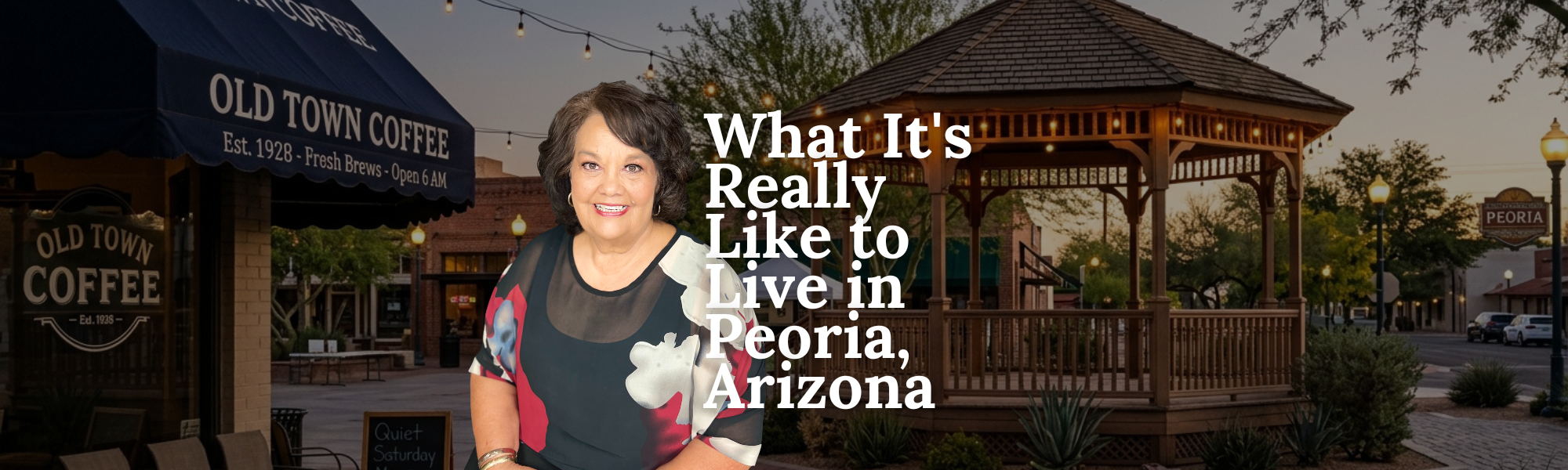
Peoria pairs a walkable Old Town core with fast-growing neighborhoods near Loop 303 — and a median home price still under $550,000 in a Valley that keeps climbing.
The first time I walked a buyer through Old Town Peoria, she stopped in the middle of Peoria Avenue and said, "Wait — this still counts as the West Valley?" I get that reaction a lot. People picture stucco subdivisions stretching to the horizon, and then they turn onto a street with string lights, a restored bandstand, and a coffee shop with a line out the door on Saturday morning.
That's the thing about Peoria. It's not one town — it's two or three towns stacked on top of each other, and which one you fall in love with depends on what you're looking for.
I've sold homes here for years now, and I still send clients to Old Town before I show them anything else, just so they see that version of Peoria exists before they default to a brand-new floor plan fifteen minutes north.
What's Old Town Peoria Actually Like to Live Near?
Old Town is the part of Peoria that predates the freeway growth — small lots, mature trees, front porches close to the sidewalk. On a Saturday morning, Peoria's Old Town farmers market (run out of the Honey Hive Farms property) draws the same regulars every week for local produce and honey. A few blocks over, Peoria Sports Complex still hosts spring training baseball every March, and the surrounding restaurants lean into that energy year-round with patio seating and a genuine walk-around-and-see-people vibe.
It's not flashy. It's the kind of neighborhood where you know your mail carrier's name.
Is Peoria Still Affordable?
This is the question I get on almost every call. The honest answer: Peoria isn't the deal it was five years ago, but it's still priced reasonably for what you get. As of mid-2026, Peoria's median single-family sale price sits at approximately $540,000, with homes moving in about 51 to 52 days and a sale-to-list ratio near 98%. That's a balanced market — not a bidding-war free-for-all, but not a buyer's paradise either.
Price per square foot varies a lot depending on where in Peoria you're looking. A 1980s single-story near the older 85345 zip code can trade in the low $200s per square foot, while a newer build up near Vistancia in 85383 runs closer to $290 per square foot. Same city, very different price tags — which is exactly why "what does Peoria cost" doesn't have one answer.
What Surprises People Who Move Here
The size. Peoria stretches roughly 180 square miles, from Olive Avenue in the south up past Lake Pleasant Parkway and the Loop 303 corridor in the north. Someone moving from a compact city assumes "living in Peoria" means one lifestyle. It doesn't. South Peoria feels established and in-fill. North Peoria, along the 303 growth corridor, is newer construction, bigger lots, and a lot more open desert between rooftops.
The other surprise is how much new development is still happening up north. That Loop 303 corridor has become the growth anchor for the whole northwest Phoenix metro, which means new retail and new employers keep showing up within a few years of a neighborhood being built — something buyers moving from a "finished" city aren't always used to.
Where Should You Start Looking?
It depends on what you're solving for. If you want walkability, mature landscaping, and a lower price per square foot, start in the established core around 85345. If you want new construction, larger lots, and don't mind a longer drive to the older part of town, north Peoria near 85383 is worth a look — that zip code's far-north edge also overlaps Deer Valley Unified School District attendance boundaries, on top of Peoria's own district, so it's worth double-checking which schools a specific address actually feeds into before you fall in love with a floor plan.
Commuters headed toward downtown Phoenix or Scottsdale tend to gravitate toward south and central Peoria for easier freeway access. Families prioritizing newer schools and community amenities often land north, near Vistancia and Lake Pleasant. Neither is "better" — it's a lifestyle-fit question, not a right-answer question.
One local secret: if you're touring Old Town on a weekend, park once near the bandstand and walk. Nearly everything worth seeing is within a few blocks, and you'll get a much better feel for the neighborhood than driving block to block ever gives you.
Frequently Asked Questions
Is Peoria, Arizona a good place to live? Yes, for a wide range of buyers — it offers both an established, walkable Old Town core and newer master-planned communities in the north, with a balanced housing market and a lower price per square foot than many nearby Valley cities.
How much does a home cost in Peoria, AZ? As of mid-2026, Peoria's median single-family sale price is approximately $540,000, with homes typically going under contract in 51 to 52 days.
What school district serves Peoria? Most of Peoria falls under Peoria Unified School District, though the far-north 85383 zip code also overlaps Deer Valley Unified School District attendance boundaries — always confirm the exact boundary for a specific address.
Is Old Town Peoria walkable? Yes. The historic core is compact enough to park once and walk to the farmers market, several restaurants, and the bandstand area, which is unusual for a West Valley city built mostly around cars.
If you're weighing Old Town charm against new-build convenience — or you're just not sure which part of Peoria fits your life — I'm happy to walk both versions of this city with you, no pressure at all.
This content is provided for informational purposes only and does not constitute legal or financial advice. All real estate services are provided in compliance with Fair Housing laws, RESPA, TCPA, the REALTOR® Code of Ethics, and Arizona Department of Real Estate advertising regulations. Equal Housing Opportunity. Gracie Vega, Realty One Group, AZ License #SA514613000.